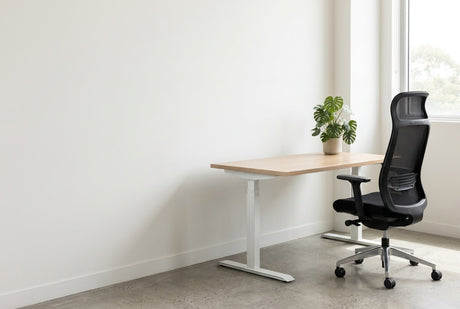
A new starter joins the team next month. She uses a manual wheelchair, and the desk you have earmarked for her is fixed-height, with a drawer pedestal under one end. Her knees will hit the pedestal, her armrests will catch the desk edge, and she will reach across a gap to the keyboard. Getting accessible office furniture right before day one is easier than fixing it in week three.
This guide covers desks, chairs, screens and visitor seating for staff with disability or injury, starting with the height-adjustable workstations that do most of the work.
Height-adjustable desks: stated limits and clear knee space
An electric sit-stand desk is usually the most useful single item. One desk can suit a wheelchair user, a person who needs to stand, or someone recovering from back surgery. Check the stated height range, and whether it includes the worktop.
The Agile Double Motor Electric Individual Desk (from $1,017) lists 645mm to 1285mm including its 25mm worktop. That puts the underside of the top at about 620mm at its lowest setting; measure the clearance under the frame rails as well.

For a wheelchair user, measure them in their own chair. Note the height of their knees and armrests, then set the desk so the underside clears both. The Agile's controller can be programmed to restrict minimum and maximum height, so the desk cannot be driven down onto armrests or thighs, and its anti-collision sensitivity can be set. The 4 point memory control with LCD readout saves preferred heights.
Knee space is about more than height. Drawer pedestals, modesty panels and cable trays all eat into the space a wheelchair needs. The Agile comes in widths from 1200mm to 1800mm and carries 160 kg evenly distributed. A 1500mm or wider top leaves room to push storage to one end and keep the centre clear.
Hand-crank desks cost less, but winding one is hard work for someone with limited grip or shoulder strength, so electric is usually the better choice.
Chairs with arms, simple adjustments and higher weight ratings
Staff with back, hip or joint conditions need more adjustment than a basic task chair offers, and controls they can reach. Arms help people lower themselves and push up to stand. A higher weight rating matters for larger users.
The Buro Aura Ergo+ Chair (from $386) is rated to 180 kg and is available with height and width adjustable arms. Seat height runs from 450mm to 580mm, and a seat slide sets seat depth between 395mm and 445mm. Seat and back angles adjust independently, and the back has ratchet height adjustment with lumbar support.

The honest drawback is the levers. They sit under the seat, which is awkward for someone with limited hand strength or a stiff back. Set the chair up with the person on their first day and write the settings down. Arms can also stop a chair sliding under the desk, so check arm height against the underside.
Seat ranges matter just as much for very tall or short staff, and our guide to office chairs for tall and short people explains how to read them. The ergonomic task chairs range has more adjustable-arm options.
Screens, storage and reach
A monitor arm lets you bring the screen closer, raise it or tilt it down. That helps people with low vision, neck conditions or a wheelchair that keeps them further from the desk edge.
The Core Single Gas Spring Monitor Arm ($116) holds one 17 to 30 inch screen weighing 2 to 9 kg. Its gas spring lets the screen be moved with minimal effort, and it tilts from -90° to +15°. It includes clamp and grommet fixings and a quick-release VESA plate. Check the monitor's weight first: a gas spring only balances screens inside its stated range.
Keep everyday files and supplies between knee and shoulder height for a seated person. A mobile pedestal can be rolled out of the knee space when the desk is lowered. More choices sit in the monitor arms range.
Visitor seating and clear circulation space
Visitors with disability need a chair they can sit in and get out of safely. Chairs with firm arms and four legs are easier than a low lounge or a chair on castors that rolls as you push up.
The Buro Lindis SafeTex 4 Leg with Arms ($459) has a fixed 460mm seat height, a 470mm wide seat and a 130 kg weight rating. Its SafeTex upholstery resists bacteria, mould and staining, and it carries AFRDI Level 6 Severe Commercial certification. It stacks, which helps when a room needs clearing for a wheelchair or walker.
For larger visitors, the Endura Max Bariatric Chair ($408) is rated to 300 kg on a fully welded steel frame. Its seat is 790mm wide and 470mm deep. The catch is size: at 880mm overall width, give it a spot of its own rather than squeezing it into a row.

Then walk the route from the entrance to the desk, kitchen and bathroom. Clear the bins, cables and boxes that narrow the aisle, and leave room beside the desk for a wheelchair to turn. If the office runs hot desks, make the accessible desk a permanent allocation.
Accessible office furniture: matching needs to features
Use this as a starting point. The employee usually knows best what works for them.
| Need | What to look for | Example in this guide |
|---|---|---|
| Wheelchair user at a desk | Stated height range, clear knee space, programmable limits | Agile Double Motor desk: 645mm to 1285mm |
| Limited grip or shoulder strength | Electric lift, memory presets, light-touch screen adjustment | Agile memory control; Core gas spring arm |
| Back or hip injury | Sit-stand desk, seat slide, adjustable lumbar | Buro Aura Ergo+: 395mm to 445mm seat depth |
| Higher weight rating | Rating above the user's weight, wider seat | Buro Aura Ergo+ 180 kg; Endura Max 300 kg |
| Needs to push up to stand | Firm arms, four legs rather than castors | Buro Lindis 4 Leg with Arms |
| Low vision or neck condition | Monitor arm with reach and tilt | Core arm: -90° to +15° tilt |
Support for accessible workplaces in Australia
Employers have obligations under the Disability Discrimination Act 1992 to make reasonable adjustments for employees with disability, which can include providing equipment. Help with the cost can come from the Employment Assistance Fund, delivered through JobAccess on behalf of the Department of Social Services. The fund's guidelines list desks or chairs among the work equipment it may approve, case by case.
Timing matters. Applications are not approved for items already bought or committed to, so get written approval before you order. Items the employer is already obliged to provide, such as standard ergonomic equipment, are not funded. Allow for lead times too: most items dispatch within 3 to 12 business days, and made-to-order items take longer.
Accessible office furniture — frequently asked questions
What desk height does a wheelchair user need?
One whose underside clears that person's knees and armrests in their own wheelchair, so there is no single right number. Measure them seated and choose an adjustable desk whose range covers it.
Are electric standing desks suitable for wheelchair users?
Yes, if the lowest setting suits the user and the knee space is clear. Look for a stated height range, programmable limits and memory presets.
What weight rating should an office chair have for a larger person?
Choose a rating comfortably above the user's weight. Our range includes task chairs rated to 180 kg and bariatric visitor seating rated to 300 kg.
Can the Employment Assistance Fund pay for a desk or chair?
It can, case by case, when the item is needed because of the worker's disability rather than being equipment the employer must already provide. Written approval must come before you buy or commit to buy.
Should visitor chairs have arms?
At least some should. Arms give people something to push against when standing, which helps older visitors and anyone with limited leg strength.
Shop the range
Start with the height-adjustable workstations and ergonomic task chairs, then add armed seating from the visitor and waiting room chairs. For a single accessible desk, the Agile Double Motor Electric Individual Desk is a strong place to begin. Metro delivery is a flat $75 per order, and prices include GST.