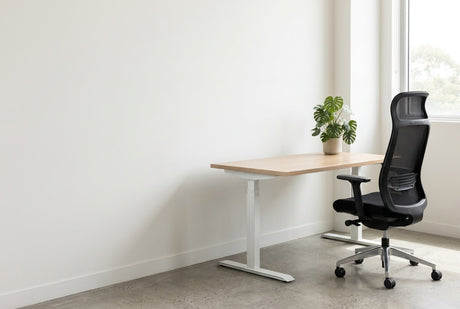
It is late afternoon, you lean back to read a long contract on screen, and your head tips back with nothing to meet it. An office chair with headrest gives your head and neck somewhere to rest whenever you recline. Not everyone needs one, and headrests differ. Some adjust in height and angle, some come as standard or as an option, and some are added later.
This guide explains who benefits, what to check and how a headrest works with recline, with seven products and prices. The chairs come from our executive office chairs and ergonomic task chairs, with specifications taken from the product pages.
Who needs an office chair with headrest?
A headrest only helps when your head reaches it. Most people sit upright or lean forward to type, so it mainly comes into play when you lean back.
- People who recline. If you lean back to read, take calls or think through a problem, a headrest gives your head a place to rest in that position.
- Long sessions. If you spend most of the day in one chair, you move between upright and reclined positions many times. A headrest supports the reclined end of that range.
- Taller users. On a medium-back chair, the backrest can finish well below a tall person's shoulders. A high back with an adjustable headrest carries support further up.
- Who can skip it. People who sit upright at the keyboard all day rarely use one. Chairs for short meetings and visitors seldom need one either, and a lower back looks lighter in a small room.
Adjustable headrests: height and angle
An adjustable headrest moves to meet the person in the chair, which matters when people of different heights share it. The Titan High Back Executive Chair ($668) has a mesh headrest with 10 locking heights above a breathable mesh back. It adds 4D adjustable arms, a seat slide and automatic adjustable lumbar support. It is rated to 135kg and has a 10-year warranty.

The Montana Chair ($459) goes a step further, with a headrest that adjusts in both height and tilt. Its seat, back and headrest are all mesh. It also has independent adjustable lumbar support, height-adjustable arms and tension control for the backrest.
Adjustable headrests are not only for mesh chairs. The Novara Executive Leather Chair ($1,247) pairs a height-adjustable headrest with a high leather back, timber veneer outer panelling and bent wood armrests. It has a synchronised tilting mechanism with tilt tension adjustment, a 120kg weight rating and a 3-year warranty.

Standard and optional headrests
Some chairs come with a headrest as standard, while others let you choose with or without. The Monarch 24/7 Controller Chair ($977) has an executive headrest above a genuine black leather back. It is rated for continuous 24/7 use, supports users up to 185kg and sits on a polished aluminium base with twin-wheel castors.

The Burton Leather Chair (from $837) comes without a headrest or with a curved one. Choosing the headrest raises the back from 575mm to 720mm, and the overall height from 995mm to 1185mm. It has padded adjustable arms, a seat slide with 4 locking positions and a 120kg weight rating.
On a tighter budget, the Hartley Mesh Chair (from $272) also comes with or without a headrest, made in moulded foam with black fabric upholstery. It has a synchron mechanism with tension control, adjustable arms as standard, a 110kg weight rating and a 10-year warranty.
The Monarch, Burton and Hartley pages list a headrest without a stated headrest adjustment, so choose them for a regular user who fits the headrest. For a chair that several people share, look for a stated height adjustment, like the Titan's. The table compares the six chairs in this guide.
| Chair | Headrest | Back | Other adjustments | Weight rating |
|---|---|---|---|---|
| Titan High Back Executive Chair | Mesh, 10 locking heights | Mesh | 28° synchro tilt, 4D arms, seat slide | 135kg |
| Montana Chair | Mesh, height and tilt | Mesh | Synchro with 3 lockable positions, lumbar, arm height | Not stated |
| Novara Executive Leather Chair | Height adjustable | Leather, timber veneer panels | Synchro tilt, tilt tension, seat height | 120kg |
| Monarch 24/7 Controller Chair | Executive headrest, standard | Genuine leather | Tilt lock, gas lift | 185kg |
| Burton Leather Chair | Curved, optional | Leather | Weight-activated synchro tilt, seat slide | 120kg |
| Hartley Mesh Chair | Moulded foam and fabric, optional | Mesh | Synchron with tension control, adjustable arms | 110kg |
How a headrest works with recline
A headrest earns its place when the back reclines. Synchro mechanisms tilt the seat and back together, so the backrest and headrest move with you as you lean back. Locking positions hold a reclined angle, and tension control sets how firmly the back resists you. Our guide to office chair mechanisms explains synchro, tilt and seat slide in more detail.
The Titan's synchronised mechanism tilts 28° and locks in five positions, with a rotating handle for recline tension. The Burton's synchro-tilt mechanism sets its own tilt tension according to your weight. Whichever chair you choose, set the headrest in the position you actually use:
- Set the chair first. Adjust seat height, seat depth and lumbar support before you touch the headrest.
- Recline to your usual angle. Lean back the way you do when reading or on a call, and lock the back there if the chair allows.
- Bring the headrest to your head. Raise or lower it until it meets the back of your head, not the top of your shoulders.
- Angle it if you can. A tilting headrest, like the Montana's, can be brought forward to meet you.
Adding a headrest to a chair you already own
Some headrests are sold as parts made for one particular chair. The Head Rest for Lotto Chair ($30) fits the Lotto Medium Back chair and adds up to 280mm to its overall height at full extension. It measures 280mm wide by 310mm high, comes in Black or White-Grey and has a 5-year warranty. It is supplied as the head rest only, and the Lotto chair is sold separately.

A headrest part only fits the model it is made for, so check the compatibility line on the product page before ordering.
Headrest chairs in Australian workplaces
- Hot desks. Where people share desks, an adjustable headrest like the Titan's or Montana's can be reset by each person who sits down.
- Control rooms and shift work. For desks staffed around the clock, choose a chair rated for that use. The Monarch is rated for continuous 24/7 use and supports users up to 185kg.
- Summer heat. In a warm office, a mesh back and headrest let air through. Leather suits an air-conditioned private office or boardroom.
- Delivery cities. Each product page has a Delivery line naming its metro cities. The Burton and Novara go to metro Sydney, Melbourne, Brisbane and Perth, and are not available for delivery in SA.
- Arrival. Deliveries go to the ground-floor entrance, and chairs arrive flat-packed unless the product page says assembled.
Office chairs with headrests — frequently asked questions
Is an office chair with a headrest worth it?
Yes, if you recline often, sit for long periods or find that a standard back finishes low on you. If you sit upright at the keyboard all day, a headrest will see little use.
Should a headrest touch your head when you sit upright?
No. Most people sit upright or slightly forward to type, so the headrest is mainly for leaning back. Set it to meet the back of your head when you recline.
Can you add a headrest to an existing office chair?
Only if a headrest is made for that model. The Head Rest for Lotto Chair, for example, fits the Lotto Medium Back chair, so check the compatibility line on any headrest you consider.
What is the difference between a fixed and an adjustable headrest?
An adjustable headrest moves up and down, and sometimes tilts, to suit different people. A fixed headrest stays in one place, which suits one regular user who fits it.
Shop the range
Every product in this guide is listed below in the order it appears. More designs are in our office chairs range.
- Titan High Back Executive Chair ($668): a mesh headrest with 10 locking heights, suited to shared desks and taller users
- Montana Chair ($459): a full mesh chair whose headrest adjusts in both height and tilt
- Novara Executive Leather Chair ($1,247): a leather and timber veneer executive chair with a height-adjustable headrest
- Monarch 24/7 Controller Chair ($977): a leather chair with headrest, rated for continuous 24/7 use up to 185kg
- Burton Leather Chair (from $837): a leather managers chair, with or without a curved headrest
- Hartley Mesh Chair (from $272): a budget mesh chair available with or without a fabric headrest
- Head Rest for Lotto Chair ($30): an add-on headrest for owners of the Lotto Medium Back chair
Metro delivery is a flat $75 per order, and prices include GST.