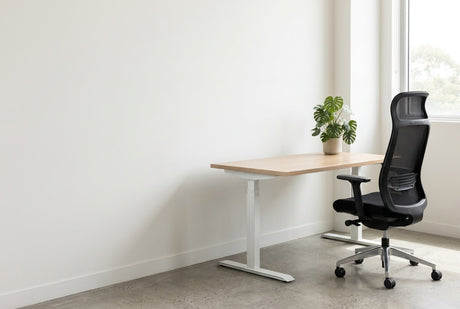
The desk sits in the middle of the room, the nearest power point is behind a filing cabinet, and nobody wants an extension lead across the walkway. Or the budget stretches to a height-adjustable desk, just not a motorised one. A manual standing desk answers both: you turn a handle and the top rises or lowers, with no motor and nothing to plug in.
This guide explains crank and winder adjustment, height range, lifting capacity, frames and tops, and how manual desks compare with electric ones. Our standing desks collection shows manual and electric models side by side.
How a manual standing desk works: crank or winder
Crank and winder are two names for the same idea. A handle at the edge of the top turns a shaft that runs through the frame, driving the legs so both sides rise together. Turn one way to raise the desk and the other way to lower it.
The Boost Crank Single Sided Workstation - Without Screen (from $529) is a typical example. It adjusts from 705mm to 1155mm, moving 10mm per full turn of the handle at up to 15mm per second. Tops come in 1200mm, 1500mm or 1800mm widths at 750mm deep, with a 50mm scallop cut out at the rear and a 10 year warranty.

Crank or gas lift?
Not every manual desk uses a crank. Gas lift, or pneumatic, desks use a gas spring and a release lever, so the top glides up or down quickly with little effort. The catch is load, because the spring can only move a light weight.
The Versarise Height Adjustable Pneumatic E-Sports Computer Desk ($561) shows the trade-off clearly. It has a static bearing capacity of 50kgs but a dynamic bearing capacity of 5kgs during height adjustment, so keep the load on the top to 5kgs or less while it moves. The 1000mm x 600mm top adjusts from 738mm to 1155mm and has an under-desk cable basket.
A crank works the other way: it lifts whatever sits on the top, up to the frame's rated capacity. The table compares the products in this guide.
| Product | Mechanism | Height range | Lifting capacity | Sizes (mm) |
|---|---|---|---|---|
| Boost Crank Single Sided Workstation | Crank | 705mm to 1155mm | Not stated | 1200, 1500 or 1800 W x 750 D |
| Versarise Pneumatic Desk | Pneumatic (gas) | 738mm to 1155mm | 50kgs static, 5kgs while moving | 1000 W x 600 D |
| Boost Crank Corner Workstation | Crank | 705mm to 1155mm | Not stated | 1500 x 1500, 1800 x 1500, 1800 x 1800 |
| Boost Crank Single Sided Frame | Crank, frame only | 680mm to 1130mm | 80 Kgs | Tops 1200 to 1800 W |
| Boost Crank Return Frame | Crank, frame only | 680mm to 1130mm | 100 Kgs on its specified main frame | Returns 1400 to 2000 W overall |
| Boost Crank Back To Back Workstation | Crank, two users | 705mm to 1155mm | Not stated | 1200, 1500 or 1800 W per user |
Manual or electric: effort, speed and cost
An electric desk moves at the press of a button, and many models store favourite heights. That convenience needs a motor, a control box and a power point at the desk. A crank asks for a little effort and more time, but there is no motor and no cable to run.
Manual suits desks that change height a few times a day or less: one person's desk set for sitting and standing, a shared desk reset by each user, or a desk far from power. It also suits a tighter budget, and the Boost Crank is described as the most affordable addition to its range. For motors, stages and speeds, see our guide to electric standing desks.
The Boost Crank Corner Workstation - Without Screen (from $912) brings the same crank to an L-shape, without the need for power outlets. It comes in 1500mm x 1500mm, 1800mm x 1500mm or 1800mm x 1800mm at 750mm deep, with an 80mm cable entry and cover.

Frames and tops: building your own crank desk
If you already have a good top, or want a size the workstations do not offer, start with a frame. The Boost Crank Single Sided Frame ($432) is telescopic, so it suits worktops from 1200mm to 1800mm wide. It has two-stage 90mm x 60mm columns, 700mm feet, an 80 Kgs lifting capacity and a 5 year warranty, in black or white powdercoat. Worktops are sold separately.

To make it an L-shape, the Boost Crank Return Frame ($277) adds a manual height adjustable return. It suits an overall return size of 1400mm to 2000mm wide and has a 500mm foot. Its listing gives a 100 Kgs lifting capacity when attached to its specified main frame, and the desk top is not included.
Whatever top you choose, match it to the frame's stated worktop range. The complete Boost Crank workstations use 25mm thick, 750mm deep tops in Natural Oak or Natural White.
Manual standing desks in Australian offices and homes
In open-plan Australian offices, power often reaches desks through floor boxes or ceiling power poles, which limits where an electric desk can go. A crank desk can sit anywhere on the floor, which helps with shared desks that each person resets when they sit down. At home, a spare room often has one double power point, already busy with a screen, a laptop charger and a lamp.
For teams, the Boost Crank Back To Back Workstation - Without Screen (from $1,034) puts two users back to back. Each gets 1200mm, 1500mm or 1800mm of width at 750mm deep, with 1500mm overall depth, the same 705mm to 1155mm range and a 10 year warranty. Our height-adjustable workstations collection has larger layouts.

These desks arrive flat-packed at the ground-floor entrance. Each product page has a Delivery line, and the Boost Crank pages list metro Sydney, Melbourne, Brisbane, Perth and Adelaide.
Manual standing desk — frequently asked questions
Is a crank standing desk hard to adjust?
No, but it takes longer than an electric desk. The Boost Crank moves 10mm per full turn of the handle, so changing from sitting to standing height takes a few dozen turns.
How much weight can a manual standing desk lift?
It depends on the mechanism: the Boost Crank Single Sided Frame lifts 80 Kgs, while the pneumatic Versarise desk holds 50kgs static but only 5kgs while it moves.
Do manual standing desks need power?
No. A crank or gas lift desk has no motor, so it can go anywhere, including the middle of a room or a corner with no free power point.
What is the difference between a crank desk and a winder desk?
There is no real difference, because both names describe a desk raised and lowered by turning a handle. Gas lift desks are the other manual type, using a lever and a gas spring instead.
Shop the range
Compare these with fixed-height and electric models in our office desks range.
- Boost Crank Single Sided Workstation - Without Screen (from $529): one person who wants a crank desk in three widths
- Versarise Height Adjustable Pneumatic E-Sports Computer Desk ($561): a compact pneumatic desk for light loads and quick changes
- Boost Crank Corner Workstation - Without Screen (from $912): an L-shaped crank desk for spots without a power outlet
- Boost Crank Single Sided Frame ($432): putting your own 1200mm to 1800mm top on a crank frame
- Boost Crank Return Frame ($277): adding a manual height adjustable return to make an L-shape
- Boost Crank Back To Back Workstation - Without Screen (from $1,034): two people sharing one crank workstation, back to back
Metro delivery is a flat $75 per order, and prices include GST.