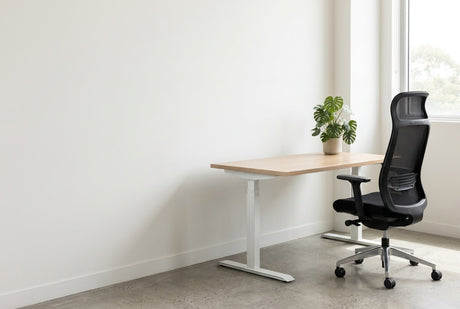
The first warm week of September arrives and the blinds go up. The open-plan floor looks exactly as it did in July: rows of desks, a long run of grey cupboards and one tired fig by the lift. Well-placed office planters change more than the look. They can mark out a quiet zone, dress up a line of storage and give a long room some depth without building a wall.
This guide compares the main planter types in our office planters range, from boxes that sit on storage to mobile and wall-style dividers. It then covers which plants suit which light, how to keep them alive and where not to put them.
Four kinds of office planters, and where each one works
Most office greenery ends up in one of four places: on top of storage, built into a cabinet, on wheels, or in a planter wall. The right one depends on what the planter has to do besides hold plants.
| Planter type | Best spot | Notes | Example in our range |
|---|---|---|---|
| Planter box on existing storage | Tops of tambour cupboards and credenzas along a walkway | Cheapest way in; match the box width to the unit below | Axis Planter Box, $147 |
| Cabinet with built-in planter | Ends of desk rows, beside meeting rooms | Storage and greenery in one purchase; pots not included | Nevada Tambour Cabinet with Planter Box, from $860 |
| Mobile planter | Breakout areas, training rooms, floors that change often | Braked castors, drip tray and acoustic panelling | Rover Mobile Planter, from $1,944 |
| Planter wall | Between two teams, or in front of a blank wall | A modular divider holding 25 pots | Planter Wall, from $1,432 |
Planter boxes that sit on storage you already have
The quickest win is storage already on the floor: a row of waist-high cupboards is a ready-made plinth for greenery.
The Axis Planter Box ($147) is the simplest start. It is powder-coated steel, 900mm wide and 450mm deep, with two Ø200mm plant holes, in 150mm or 250mm heights. It is made to pair with Tambour units, and plants and pots are not included.

For longer runs, the Tempo Planter Box (from $209) comes in 900mm, 1200mm or 1530mm widths, all 200mm high and 450mm deep. It is powder-coated steel in Classic White or Black Graphite, made to sit on storage units and credenzas. Match the width to the unit underneath, because a box that overhangs looks like an afterthought and gets knocked.
If you are buying storage anyway, a cabinet with the planter built in saves a step. The Nevada Tambour Cabinet with Planter Box (from $860) holds files and samples under an integrated planter top. It comes in Black or White, at W900 x D450 x H1220mm, W1200 x D450 x H1220mm or W900 x D450 x H1400mm.

The 1220mm versions keep the planter top well below standing eye height, so low planting still leaves a view across the floor. The 1400mm version adds more screening between desks. More tambour and sliding door units are in our tambour and sliding door cabinets range if you want plain cupboards to sit alongside.
Using planters to divide zones and soften sound
Plants make a softer boundary than a screen. A line of greenery signals a different zone, such as a quiet corner or meeting nook, without closing it off.
Plants on their own do little for noise. Soft, porous surfaces absorb sound, so a planter's construction matters more than what grows in it.
The Rover Mobile Planter (from $1,944) is the one built with sound in mind. Its 50x50mm FSC-certified maple hardwood frame is wrapped in recycled acoustic board rated at 0.9 NRC, which means it absorbs most of the sound that reaches it. It has three fixed-height shelves, a metal drip tray and four large medical-grade castors with built-in brakes.

It comes in W900 x H1620mm or W900 x H1920mm, with a 10 year warranty. The trade-offs are real: it is the dearest option here, plants and pots are not included, and it needs tools to put together because it has no pre-drilled holes. Once built, it rolls wherever a boundary is needed.
For a fixed divider, the Planter Wall (from $1,432) is a timber and steel frame holding 25 pots for real or artificial plants. It is compatible with Plantation workstation systems and comes either with no plants or with plants included. If sound is the main problem, pair planters with panels from our acoustic wall panels range.
Choosing plants for the light you actually have
Walk the floor at midday and note where the light really falls. Desks two or three metres from a window often get far less light than they appear to.
- Low light, inner desks and corridors: ZZ plants, snake plants, devil's ivy and peace lilies are the forgiving choices.
- Bright, indirect light near windows: rubber plants, monstera and dracaena do well out of harsh direct sun.
- Trailing over planter boxes: devil's ivy and heartleaf philodendron spill over the edge of a box on a cupboard and soften its hard line.
- No natural light at all: use artificial plants, or real ones under grow lights on a timer.
Artificial plants suit spots nobody will water, but they still need dusting.
Watering, maintenance and placement
Overwatering is a common way to lose office plants. Check weekly and water only when the top few centimetres of soil are dry, and less often in winter.
Keep plants in their own pots inside the planter rather than filling a box with soil, so a struggling plant can be swapped in minutes. Size pots to the planter, such as the Axis's Ø200mm holes.
Water and files do not mix. The Rover's metal drip tray handles run-off, but for a planter that sits above documents, use pots with saucers or liners so overflow cannot reach the cabinet.
Placement is a safety question as much as a design one:
- Keep planters out of walkways, doorways and exit paths, and keep trailing stems off the floor.
- Lock the castors on mobile planters once they are in place.
- Keep water away from power boards and floor boxes.
- Give one named person the watering job, so it does not fall between everyone.
Spring, air-con and the summer shutdown
September is a good month to start, because indoor plants put on new growth as the days lengthen.
In Australia, north-facing windows get the most sun, and west-facing glass gets hot on summer afternoons. Keep soft-leaved plants back from western windows, and away from air-conditioning vents, which dry leaves quickly.
Plan for the Christmas and New Year break before it arrives. Water deeply on the last day, move plants back from hot glass and agree who checks the office mid-break. In a shared-desk office nobody owns the plant beside them, so put greenery on shared furniture with a named carer; our guide to hot desking furniture for a shared office covers how those floors work.
Office planters — frequently asked questions
What are the best plants for an office with no windows?
Real plants need some light, so a room with no windows needs artificial plants or grow lights on a timer. Where there is a little light, ZZ plants and snake plants are the most forgiving.
How often should office plants be watered?
Check them once a week and water only when the top few centimetres of soil are dry. Most office plants need less water in winter, when growth slows.
Do office planters help reduce noise?
Only a little, unless the planter itself is made from acoustic material. Leaves absorb very little sound, but the Rover Mobile Planter is wrapped in recycled acoustic board rated at 0.9 NRC, and acoustic wall panels nearby add more absorption.
Can you put a planter box on top of a cupboard or filing cabinet?
Yes, if the planter is made for the unit and matches its width. The Axis pairs with Tambour units and the Tempo sits on storage units and credenzas; use saucers or liners to protect what is stored below.
Shop the range
Start with our office planters for boxes, mobile planters and cabinets with built-in planter tops. For a long run of greenery on storage, the Tempo Planter Box comes in three widths to match the cupboards below. Metro delivery is a flat $75 per order, and prices include GST.